What are Some of The Best Wholesale Clothing Jeans?
- 获取链接
- X
- 电子邮件
- 其他应用
In the global apparel market, denim never loses its edge. It doesn’t soften its impact over time—it sharpens it. Buyers who understand this space know one truth: denim is not just clothing, it is volume-driven power, margin structure, and long-term demand stability. Every season, every region, every retail channel keeps pulling denim back into center stage. And at the core of this demand cycle sits one category that refuses to slow down: Wholesale Clothing Jeans.
Brands rise and fall, trends shift overnight, but jeans remain a constant battlefield of competition, pricing pressure, and design evolution. Those who control supply control the game. Those who hesitate lose position. This is not a soft market—it is a fast, aggressive, global supply chain race built on scale, consistency, and precision manufacturing.
The Unstoppable Core of Denim Demand and Market Pressure
The denim industry is driven by one uncompromising reality: volume sells, and consistency wins. Retailers, distributors, and online sellers are no longer looking for occasional suppliers—they are searching for stable pipelines that can sustain continuous inventory flow.
At the center of this demand ecosystem is Bulk Jeans, a category that defines how modern wholesale apparel moves across borders. Bulk purchasing is no longer just a cost-saving strategy; it is a survival mechanism in competitive retail environments. The ability to secure consistent quality across thousands of units determines whether a business scales or stagnates.
The global appetite for denim is also shaped by versatility. Jeans are not confined to one demographic or lifestyle. They move across streetwear, business casual, travel fashion, and seasonal collections. From urban youth culture to mature minimalist styling, denim adapts without resistance.
This is exactly why suppliers who specialize in Wholesale Clothing Jeans dominate procurement channels. They don’t just sell garments—they manage expectation cycles, production timing, fabric consistency, and delivery stability.
In this landscape, hesitation is costly. Retailers cannot afford inconsistent wash shades, unstable sizing, or delayed shipments. Every failure in supply chain execution directly translates into lost market share. Denim rewards those who operate with precision and punishes those who improvise.
The aggressive truth of this industry is simple: denim is easy to sell, but hard to master.
Fabric Engineering, Style Variation, and Market-Driven Product Design
Behind every successful denim product lies a structured engineering process. Fabric selection is not decorative—it is functional strategy. High-quality denim must balance softness, durability, elasticity, and shape retention. Any weakness in these factors leads directly to returns, complaints, and brand damage.
Modern manufacturers now prioritize advanced washing and finishing techniques. Enzyme wash, stone wash, snow wash, vintage fade, whisker detailing, distressed ripping, and whitening effects are no longer optional—they are standard expectations in competitive markets. These processes transform basic denim into retail-ready fashion assets.
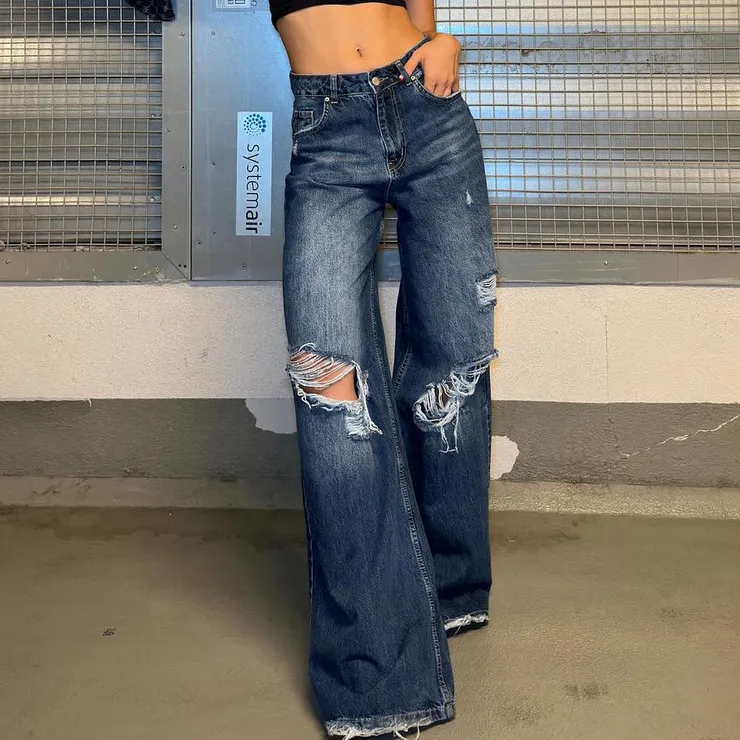
In the global supply ecosystem, categories such as Wholesale Womens Jeans are especially dynamic. Women’s denim is no longer limited to basic skinny fits or straight cuts. It now spans wide-leg silhouettes, high-waist shaping jeans, cropped designs, flare cuts, and hybrid fashion interpretations that merge comfort with visual impact.
Retail buyers demand flexibility. They want collections that can shift between minimalist neutral tones and bold statement washes without disrupting inventory balance. That is why color variety matters as much as cut variety. Classic blue, deep indigo, light wash, black denim, grey tones, and seasonal fashion colors all coexist within modern wholesale catalogs.
Manufacturers that fail to expand style diversity lose relevance quickly. The market does not reward repetition—it rewards adaptation.
On the men’s side, Wholesale Jeans Mens continues to push strong volume performance globally. Men’s denim focuses heavily on durability, structure, and fit stability. Straight cuts, slim fits, tapered silhouettes, cargo-inspired denim, and functional pocket designs dominate demand. Men’s denim buyers prioritize long-term wearability and consistent sizing across production batches.
Children’s denim represents another fast-growing segment. Wholesale Children Jeans must meet stricter safety standards, softer fabric requirements, and enhanced flexibility. Parents prioritize comfort and durability, while retailers prioritize repeat purchasing cycles as children outgrow sizes quickly. This creates a high-frequency reorder ecosystem that supports stable wholesale demand.
Across all segments, one truth remains unchanged: design is not aesthetic alone—it is commercial engineering.
Supply Chain Control, Manufacturing Authority, and Category Expansion
The denim industry does not operate on creativity alone. It operates on manufacturing authority. Factories that control production capacity, fabric sourcing, and finishing consistency dominate the supply chain.
In this structure, categories like Denim Jacket Manufacturers represent more than outerwear production. Denim jackets are a seasonal anchor product that stabilizes brand collections during transitional weather cycles. They extend denim identity beyond pants into layered fashion systems. Oversized jackets, cropped styles, embroidered designs, washed vintage finishes, and insulated winter versions all contribute to a diversified product ecosystem.
Similarly, Denim Shorts Supplier networks play a crucial role in warm-season collections. Denim shorts are high-rotation products in summer retail cycles. They require precise cutting, reinforced stitching, and controlled distressing to maintain both aesthetic appeal and structural durability. Suppliers who fail to maintain consistency in short-length denim production often lose access to large retail chains and e-commerce platforms.
OEM and ODM capabilities have become non-negotiable in modern denim manufacturing. Buyers demand customization at every level—fabric weight, color matching, label design, logo placement, packaging identity, and fit modification. This is where Custom Made jeans becomes a critical differentiator in the global supply chain.
Custom production is no longer reserved for luxury brands. Even mid-tier retailers now demand tailored denim solutions to build brand identity in saturated markets. The ability to modify waist structure, adjust leg tapering, select wash intensity, and integrate branded hardware defines competitive advantage.
Factories that provide full customization services gain stronger long-term contracts because they are not just suppliers—they become production partners.
Speed is another defining factor. Fast fashion cycles demand rapid product turnover. New collections must move from sampling to production to shipment in compressed timelines. Suppliers who cannot match this pace are eliminated from competitive bidding processes.
Quality control remains the final gatekeeper. Every batch must meet strict standards: stitching integrity, color consistency, shrink resistance, and fabric durability. Even small deviations can trigger large-scale rejection from buyers.
In this environment, manufacturing is not just production—it is controlled precision under pressure.
Global Wholesale Strategy, Market Aggression, and Profit Architecture
The denim wholesale business is structured around one core principle: scalability creates dominance. Retailers, distributors, and e-commerce sellers all depend on predictable supply chains that allow them to scale without risk.
This is where wholesale strategy becomes decisive. Businesses operating in Wholesale Clothing Jeans must balance three forces simultaneously: pricing competitiveness, product variety, and delivery reliability. If any one of these elements fails, the entire commercial structure weakens.
Global buyers are increasingly aggressive in procurement decisions. They compare suppliers not only on price but on production transparency, minimum order flexibility, and replenishment speed. Small batch testing followed by large-scale ordering has become standard practice. Suppliers that allow flexible MOQ structures gain stronger market penetration.
Export-grade production standards are no longer optional. International buyers expect compliance with labeling regulations, fabric certification, and packaging standards. This is particularly important for brands entering North American and European markets, where consumer expectations are strict and enforcement is high.
Product segmentation also plays a strategic role. Successful suppliers do not rely on a single category. Instead, they build interconnected denim ecosystems:
- Bulk Jeans for high-volume retail distribution
- Wholesale Womens Jeans for fashion-driven consumer markets
- Wholesale Jeans Mens for stable, repeat-purchase demand
- Wholesale Children Jeans for high-frequency replacement cycles
- Denim Jacket Manufacturers for seasonal outerwear expansion
- Denim Shorts Supplier for summer collection acceleration
- Custom Made jeans for brand differentiation strategies
Each category supports the others. Together, they form a full-cycle denim supply network that reduces dependency risk and increases revenue stability.
Profit in this industry is not random—it is engineered through scale optimization, production control, and demand forecasting. Suppliers who understand this structure build long-term dominance. Those who ignore it remain trapped in low-margin competition.
The denim market does not reward hesitation, imitation, or inconsistency. It rewards control, volume intelligence, and manufacturing precision. Whether dealing with Bulk Jeans, expanding Wholesale Clothing Jeans catalogs, or developing niche lines like Wholesale Womens Jeans, the direction is clear: scale aggressively, produce consistently, and adapt without delay.
From factory floor to global retail shelves, denim remains one of the most unforgiving yet profitable segments in fashion. And in this arena, only those who execute with discipline and speed maintain their position at the top.
- 获取链接
- X
- 电子邮件
- 其他应用


评论
发表评论